Thursday, May 26, 2011

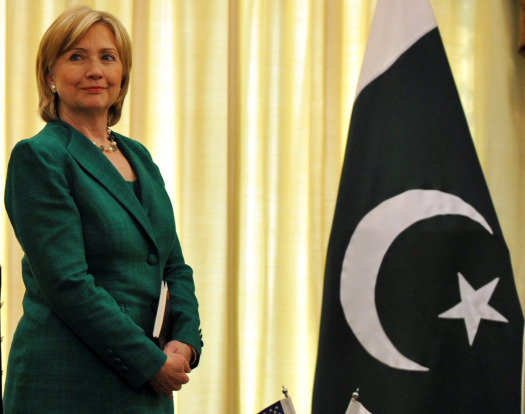
Hillary Clinton makes surprise visit to Pakistan

US Secretary of State Hillary Clinton arrived in Pakistan Friday on a surprise visit aimed at resolving tensions raised by the killing of Osama Bin Laden


US Secretary of State Hillary Clinton arrived in Pakistan Friday on a surprise visit aimed at resolving tensions raised by the killing of Osama Bin Laden near Islamabad.
The top US diplomat is to meet with Pakistani President Asif Ali Zardari, army chief General Ashfaq Kayani and the chief of Pakistan's powerful intelligence agency Ahmad Shuja Pasha, the State Department said.
Clinton, who is accompanied by chairman of the US Joint Chiefs of Staff Admiral Mike Mullen, is expected to demand more cooperation from Pakistan in the fight against Al Qaida and Taliban militants.
During the meetings in Islamabad she will also likely push for an investigation into Bin Laden's time as a fugitive in Pakistan, and help push for a political solution to the long war in Afghanistan.

Deadly street battles in Yemen claim 40 lives


More than 40 Yemenis were killed in pitched street battles in the capital on Thursday as fighting aimed at ending President Ali Abdullah Saleh's three-decade-long rule threatened to ignite civil war.
Residents were hurriedly strapping furniture, stoves, baby cots and other possessions to the roofs of cars and trucks and streaming out of Sana'a by the thousands, hoping to escape the violence that has killed more than 80 people since Monday.
The fighting, pitting the security forces of Saleh against members of the country's most powerful Hashid tribe led by Sadiq Al Ahmar, was the bloodiest Yemen has seen since protests began in January.
Arrests ordered
The defence ministry said 28 people were killed in an explosion in an arms storage area of Sana'a at dawn yesterday.
Fighters in civilian clothes roamed some districts and machinegun fire rang out sporadically.
Black smoke from mortar fire mixed with a haze of pollution and dust that hangs over Sana'a like a shroud.
On Wednesday Washington ordered all non-essential diplomats and embassy family members to leave Yemen. Yemen's state prosecutor ordered the arrest of ‘rebellious' leaders of the tribal group led by the Al Ahmar family and a government official said the headquarters of an opposition television station had been ‘destroyed' while a government official had said the airport was briefly closed due to the fighting but had reopened.
Saleh must go, G8 says
Leaders of the Group of Eight called on Yemen's president to quit on Thursday.
Summit host France said Yemen's President Ali Abdullah Saleh must end his 33-year rule: "We deplore the fighting that occurred overnight which was a direct result of the current political impasse, for which President Saleh has direct responsibility due to his refusal to sign the GCC transition agreement," a foreign ministry spokesman said, referring to the Gulf Cooperation Council.
"We continue to support the departure of President Saleh who has consistently agreed that he would be stepping down from power and then consistently reneged on those agreements" US Secretary of State Hillary Clinton said.

At least 8,000 Muslim men, boys slain when Serbs overran U.N. safe haven


STORY HIGHLIGHTS
  • At least 8,000 Muslim men, boys slain when Serbs overran U.N. safe haven
  • Mladic, then Bosnian Serb commander, is accused of direct involvement in the violence
  • Judge: Srebrenica "truly scenes from hell written on the darkest pages"

It is now remembered as the worst atrocity in Europe since World War II.
In a five-day orgy of slaughter at Srebrenica in July 1995, up to 8,000 Muslims were systematically exterminated in what was described at the U.N. war crimes tribunal as "the triumph of evil."
Former Bosnian Serb commander-in-chief General Ratko Mladic, who is accused of direct involvement in the genocide at Srebrenica, was arrested on Thursday after more than 15 years on the run.
In 1995, Srebrenica was designated a U.N. "safe area."
A judge at The Hague tribunal was later to describe what happened there as "truly scenes from hell written on the darkest pages of human history."
Thousands of Bosnian Muslims had sought refuge in the spa town of Srebrenica in 1995 as the Bosnian Serb army marched towards them.
Mass Grave
They were protected by just 100 lightly equipped Dutch peacekeepers -- who proved no match for the advancing, heavily-armed Serb army.
Denied reinforcements, the Dutch were forced to stand aside while Serb troops intent on "ethnic cleansing" did their worst -- the peacekeepers even witnessing the summary execution of civilians.
In the days before the onslaught, 30,000 Muslims fleeing the advancing Serb army were crammed into the town. Within days there was not one Muslim left.
A great number fled -- only for many of them to be wiped out in Serb ambushes -- but the men who stayed fared the worst.
Thousands of men and boys as young as 10 were rounded up and murdered. Those who tried to hide in their homes were, according to evidence at the trial of Serb General Radislav Krstic at The Hague in March 2000, "hunted down like dogs and slaughtered."
Serbian TV footage shows women and children being separated from the men and put on buses.
In a sickening show of "reassurance" Mladic -- now on the war crimes tribunal's most wanted list -- told the women everyone would be taken out by bus out and safely reunited.
When the cameras were turned off the real face of the Serb army emerged as the slaughter began.
More than 60 truckloads of refugees were taken from Srebrenica to execution sites where they were bound, blindfolded, and shot with automatic rifles.
Some of the executions were carried out at night under arc lights. Industrial bulldozers then pushed the bodies into mass graves.
Some were buried alive, a French policeman who collected evidence from Bosnian Muslims, Jean-Rene Ruez, told The Hague tribunal in 1996.
He gave evidence that Bosnian Serb forces had killed and tortured refugees at will. Streets were littered with corpses, he said, and rivers were red with blood. Many people committed suicide to avoid having their noses, lips and ears chopped off, he said.
Among other lurid accounts of mass murder, Ruez cited cases of adults being forced to kill their children or watching as soldiers ended the young lives.
"One soldier approached a woman in the middle of a crowd," he said. "Her child was crying. The soldier asked why the child was crying and she explained that he was hungry. The soldier made a comment like, 'He won't be hungry anymore.' He slit the child's throat in front of everybody."
Later it was revealed that Mladic had been able to press on unhindered by issuing ultimatums to the U.N. protection force.
It was suggested the U.N. high command had promised to stop air strikes against the Serb army in return for the release of 370 U.N. soldiers held prisoner -- and Mladic took this as the green light to attack Srebrenica.
The Commander of the Dutch U.N. troops, Col. Thomas Karremans, told The Hague tribunal in 1996 that he had first requested NATO air strikes when Mladic's troops began their assault on July 6, but that the request was not granted until July 11 when Srebrenica fell. By then, Karremans said, it "was too late and too little."
Karremans said a long Serb blockade before the attack had left the lightly armed Dutch battalion desperately short of food and fuel, but requests for fresh supplies went unheeded.
In 1999 the U.N. admitted its error in expecting 100 Dutch troops to deter the Bosnian Serb army.

Former Pakistan President Musharraf: America's Osama raid "technically... an act of war"


Piers Morgan interviewed former Pakistan President Pervez Musharraf today for a program that airs later this week. Musharraf responds to America's raid that killed Osama bin Laden, and President Barack Obama's comments this week that he would do the same thing again. "No country has a right to intrude into any other country," said Musharraf. "Actually, technically, legally, you see it, it's an act of war. So I think it is an irresponsible statement, and I think such arrogance should not be shown, publicly, to the world."
He went on to further explain the "act of war" comment:
"Theoretically, technically, yes indeed, it's an act of war," he said, but noted it wouldn't necessarily signal a war. "How to deal with it is the question, and I leave it to the government there to how they want to deal with it."

7 U.S. soldiers among 8 killed in IED attack in Afghanistan


Eight NATO soldiers -- seven of them Americans -- were killed Thursday when two improvised explosive devices blew up in southern Afghanistan, according to the International Security Assistance Force and the Pentagon.
A coalition military official said the attack occurred in the Shorabak District, a remote area in the southeastern part of Kandahar Province, approximately 100 kilometers (about 62 miles) south of the city of Kandahar. It's the same region in which Taliban forces unleashed multiple attacks earlier this month in their so-called spring offensive.
The devices exploded one after the other, the official said.
ISAF did not identify the nationalities of the soldiers, but Pentagon spokesman Col. Dave Lapan said Thursday afternoon that seven of them were American.
Both U.S. and Canadian troops are deployed in the region.

PayPal swiftly slaps Google with mobile payment suit

Just this morning we reported on the rather jovial atmosphere at Google's big mobile payment announcement -- well, it looks like PayPal's prepared to bring an end to the celebration. According to Bloomberg, PayPal filed a suit against Google today in a California Superior Court, alleging that former PayPal executive, and one of this morning's MCs, Osama Bedier misappropriated the company's trade secrets. The suit further fingered Stephanie Tilenius, also formerly with PayPal, of violating the terms of her contract in recruiting Bedier. Though we've yet to get our hands on any clear details about which trade secrets PayPal's pointing to, we'd say the timing speaks volumes.

Wednesday, May 25, 2011

10 business e-mails you shouldn't send

STORY HIGHLIGHTS
·         Stick to Helvetica and people will remember your sentiment instead of your typeface
·         Don't ramble -- you have about three sentences to get a co-worker's attention
·         Do you have important news? Then say so in your subject line
·         Don't conduct business over Facebook, which is for play time


Imagine a tiny boat afloat on a thrashing sea, water pouring through a gaping hole in the hull.
A sailor is frantically bailing dark, angry water, but no matter how much he scoops, the water line never seems to recede -- more waves just pummel him in the face like a particularly insecure middle-school bully.
That, my friends, is our metaphor for the average worker's e-mail inbox.
Yeah, we know, there are tons of new communication technologies out there, but e-mail still reigns supreme in the worker realm: A recent study even shows that e-mail eats up the most mobile time among Americans.
Which is why we think it's high time to outline some of the most annoying practices when it comes to business e-mails -- practices that might make your compatriots drown themselves in frustration.
Read on to avoid making these 10 mistakes:
1) "YELLING"
Ever get an e-mail like this?
Subject line: MY CLIENT URGENTLY NEEDS TO SPEAK WITH YOU!
Hot tip: When you type in all caps, you're basically likening yourself to those crazy dudes who yell about the End Times on the subway (who are perhaps a bit subdued at present). Yeah, no one wants to talk to you.
2) Going all kindergarten with your fonts
Remember when LeBron James spurned the Cleveland Cavaliers and joined forces with the Miami Heat, prompting Cavaliers owner Dan Gilbert to pen a long letter on the team website tearing into James?
Remember what font Gilbert used? That's right, Comic Sans -- aka "The Great Underminer." Stick to Helvetica, folks, and people will remember your sentiment instead of your poor choice of typeface. (To say nothing of pink fonts and Word Art-like signatures splashed across floral graphics.)
3) Misnomers
Unless you are supremely stupid, senile or illiterate, there is no real excuse for getting a business contact's name wrong, because it's right there in his/her e-mail address. Consider this cautionary tale.
If you're prone to typos, well, then, that's what copy-paste is for.
4) Emoticons
As we have stated in the past -- back when we called for a brief break from the smiley -- emoticons have reached "STD-like proportions since their inception, spreading from one person to another like particularly expressive herpes."
OK, we can see the necessity of using a placating "smiley" in an e-mail to a contact who might need a spoonful of sugar to make the "your idea sucks" medicine go down. But nix emoticons from any initial e-mails with new contacts.
5) Overly informal greetings
"Helloz Sar-Sar! Imma tell you about a super rad product that, let's face it, all of us gurlz should totally peep if you have a burnin' hot love life but want to avoid burnin' hot other things (you know what I'm talkin' about!)."
No one has a strong enough stomach to deal with epistles of this sort on a daily basis. Save the LOLCat speech for when you're old and gray and shooting off adorable, kitten-packed e-mails to your grumbling grandkids. They can't fire you for being obnoxious.
6) Rambling
Allow me to narrate the internal dialogue of the average desk-bound minion: "Spreadsheets sure have a lot of lines... I'm hungry... I hope no one notices this hickey that Joe from accounting gave me after Happy Hour last night.... I'm hungry... Look! There's a blue bird outside and it cocked its head at me!"
Get to the point. You have approximately three sentences to cut through said desk worker's mental clutter before she -- Oh, someone sent me a video of a dog hugging a turtle!
7) Unclear subject lines
Do you have important news? Then, by all means, say so in your subject line. Hiding a vital correspondence behind a "Subject Line: Hey" is not doing anyone any favors -- except for your competition.
8) Sending too many e-mails in a row
You probably spend, oh, 20 hours per day glued to some form of computer-esque device (soon the machines will destroy us all), which means that when you don't receive an immediate response to your e-mail, it's possible to, well overreact -- much like a clingy lover waiting for an answer on that "Dinner tonight, then a different kind of spooning?" text.
Don't be a desperate loser. Wait at least 24 hours before sending a follow-up e-mail, unless it's an emergency, in which case there's this handy thing called the phone or, you know, the five-second walk over to your co-worker's desk. Yeah, we know, real life communications are hard.
9) Clip art
I imagine most of you are intelligent enough to figure out why this is not OK.
10) Not using the right method of contact
Never message a business contact on Facebook. Seriously. Why? Because Facebook is where you go to look at pictures of people from high school when you're drunk -- there's even a plug-in to prevent you from ruining your social media life whilst whiskey-soaked.
Sending a business-oriented message via Facebook is like wandering into a debauched party and expecting everyone to listen to you when you start talking about sales figures.
If you're having issues finding someone's professional contact info, sure, send him/her a message on Facebook or Twitter asking them for that info, but don't carry on a whole convo right then and there.
Unless you're looking for dirt on said contact, in which case be sure to send the ol' message at around 4 a.m., when his defenses are down.